
Azure Penetration Testing Training
Azure's attack surface is dominated by identity. Entra ID (formerly Azure AD) sits at the center of every Azure and Microsoft 365 environment, managing authentication, authorization, and trust relationships across cloud resources, SaaS applications, and hybrid on-premises infrastructure. Compromising a single Entra ID identity can cascade into access across Azure subscriptions, SharePoint sites, Exchange mailboxes, and Teams conversations, often without triggering a single network-level alert.
This identity-centric attack surface is what makes Azure penetration testing fundamentally different from traditional infrastructure assessments. Groups like Storm-0558 forged Azure AD tokens to compromise government email accounts. APT-29 exploited hybrid identity trust (Pass-the-PRT, Golden SAML) to bridge from compromised on-premises Active Directory into Azure AD tenants. The attacks that matter in Azure exploit trust, not vulnerabilities.
Azure Attack Techniques Covered
Entra ID (Azure AD) Exploitation
Entra ID is the primary target in any Azure engagement. Key attack techniques include:
- Password spray attacks against Azure AD endpoints, often bypassing lockout policies through careful timing and the legacy auth endpoints that some tenants still expose
- Device code phishing, abusing the OAuth device authorization flow to steal tokens. The victim authenticates on a legitimate Microsoft page while the attacker captures a refresh token with persistent access
- Application consent phishing, tricking users into granting OAuth permissions to attacker-controlled applications. A single click can grant read access to all mailboxes in the organization
- Conditional Access bypass, identifying trust exceptions for specific applications, locations, or device platforms that create authentication gaps
- Entra ID role abuse, exploiting overly permissive directory role assignments (Application Administrator, Cloud Application Administrator, Privileged Role Administrator) to escalate within the tenant
Azure RBAC Privilege Escalation
Azure's Role-Based Access Control operates at subscription, resource group, and resource levels. Escalation paths include:
- Managed identity abuse, Azure VMs, App Services, and Functions with system-assigned managed identities inherit permissions that can be exploited from compromised workloads
- Custom role misconfigurations, overly broad
Microsoft.Authorization/roleAssignments/writepermissions allow self-escalation - Automation Account exploitation, RunAs accounts and managed identities attached to Automation Accounts often have subscription-level Contributor access
- Key Vault access policy abuse, extracting certificates, keys, and secrets from Azure Key Vault when access policies are overly permissive
Microsoft 365 Tenant Attacks
M365 is not a separate target. It shares Entra ID with Azure. Techniques include:
- Mailbox delegation abuse, hidden forwarding rules, delegate access, and transport rules that exfiltrate email
- SharePoint and OneDrive enumeration, discovering sensitive documents through Graph API and search endpoints
- Teams message extraction, accessing private channels and chat history through compromised tokens
- Power Platform abuse, Power Automate flows with elevated connector permissions as persistence mechanisms
Hybrid Identity Attacks
Organizations with hybrid Entra ID Connect deployments expose unique attack surfaces:
- Pass-the-PRT, extracting the Primary Refresh Token from Azure AD-joined devices to impersonate users and bypass MFA
- Golden SAML, stealing the AD FS token-signing certificate to forge authentication tokens for any federated user
- Azure AD Connect exploitation, the sync server holds credentials with DCSync-equivalent permissions in both on-premises AD and Azure AD
- Seamless SSO abuse, extracting the AZUREADSSOACC$ computer account password to forge Kerberos tickets for cloud authentication
Azure Function and Logic App Abuse
Serverless compute in Azure presents similar risks to AWS Lambda but with Azure-specific attack patterns. Functions with HTTP triggers may expose internal APIs. Logic Apps with managed identities can be manipulated to perform privileged operations. Both can be abused as pivot points when their connected service credentials are overly permissive.
The MCRTP Bootcamp
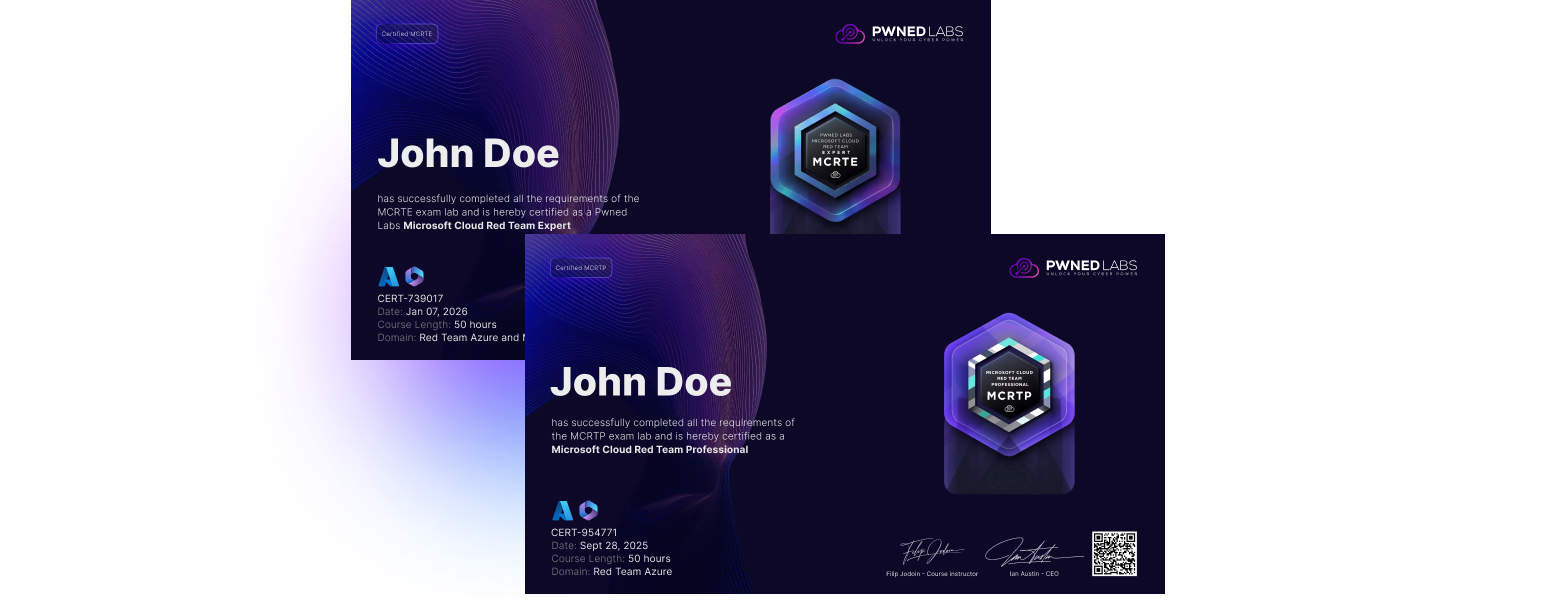
The Microsoft Cloud Red Team Professional (MCRTP) bootcamp at Pwned Labs provides hands-on training across all of these Azure and M365 attack techniques. Labs run on real Azure tenants with real Entra ID configurations, not simulated environments.
Key areas covered:
- Entra ID exploitation, credential attacks, token abuse, application consent phishing
- Azure RBAC privilege escalation and managed identity abuse
- Microsoft 365 compromise, mailbox, SharePoint, Teams attack chains
- Hybrid identity attacks, Pass-the-PRT, Golden SAML, AD Connect exploitation
- Detection engineering with Microsoft Sentinel, Defender XDR, and KQL
- Purple team methodology, attack execution paired with detection logic
Tools used include ROADtools for Entra ID enumeration, AzureHound for attack path mapping, TokenTactics for OAuth token manipulation, and the Microsoft Graph API for direct tenant interaction.
The MCRTP certification exam tests real execution: you conduct a multi-stage attack against a live Azure/M365 environment, document findings, and provide actionable detection recommendations.
The MCRTE Bootcamp (Expert Edition)
Once you have the professional-level foundation, the Microsoft Cloud Red Team Expert (MCRTE) bootcamp extends into advanced, end-to-end Microsoft Cloud attack chains and detection engineering across the full kill chain. It is a self-paced, on-demand program with more than 50 hours of training, lifetime lab access, and two exam attempts. MCRTP is excellent preparation but is not a prerequisite.
The Expert Edition is built around three pillars: attacking Entra ID and Microsoft 365, hybrid attacks, and detection engineering across the full kill chain. Rather than isolated techniques, it emphasizes complete exploitation paths that mirror how modern red teams and threat actors operate. Advanced areas covered include:
- Modern initial access, including single-factor and MFA phishing, browser injection, and ESTS cookie abuse
- Token theft, exchange, and upgrade attacks, leveraging PRT, WHfB, FoCI, NAA, and device-based tokens for stealthy lateral movement
- Workload identity and service principal compromise, including app-role infiltration and app-layer takeover
- Cloud implant delivery through Microsoft Intune and hybrid connection mechanisms such as Azure Arc
- Pivoting from Azure workloads into on-premises networks by abusing Function App hybrid connections, Automation Account credentials, and VPN gateways
- Token broker file theft and Continuous Access Evaluation (CAE) manipulation for resilient, stealthy access
- Hybrid attack chains spanning multiple Entra ID tenants and on-premises AD domains, mapped with SharpHound, AzureHound, and BloodHound
The defensive half of the program is equally hands-on. Practitioners tune Microsoft Defender XDR and Microsoft Sentinel, build and validate KQL detections by replaying the exact tradecraft used in the offensive labs, and produce response playbooks for each phase of the kill chain. The MCRTE exam is a fully hands-on, scenario-based assessment that requires chaining Entra ID, Intune, Microsoft 365, and Active Directory into a complete exploitation path across a live hybrid environment.
Why Azure-Specific Training Matters
Azure's security model is deeply tied to Microsoft's identity platform. You cannot effectively pentest Azure without understanding Entra ID, OAuth 2.0 flows, and the trust relationships between Azure subscriptions, M365 tenants, and on-premises Active Directory. Generic cloud security training that treats AWS, Azure, and GCP as interchangeable misses the identity-centric nature of Microsoft's cloud entirely.
The MCRTP bootcamp is designed for this reality. If Azure and Microsoft 365 are in your scope, this is where to build the offensive skills that match the actual threat landscape.
%201%20(1).png)